Why Durability Is The Smartest Growth Strategy
Most brands assume durability is a trade-off. Build something that lasts, sell less of it. It sounds logical. But it misreads how durability actually moves through a market.
The textile industry has defaulted to volume as its primary growth lever for decades. More styles, faster cycles, lower prices. The result is a market saturated with products that don't last and customers who have learned not to expect them to.
Durability challenges that model. And for the brands willing to lead on it, the opportunity is real.
The Misconception Holding Brands Back
If a garment lasts five years instead of two, the customer buys it less often. From a short-term revenue perspective, that looks like a problem.
But this logic only holds if you assume the total pool of customers stays fixed. It doesn't.
Durable products already exist in the market. The gap isn't supply, it's visibility. Consumers don't know where to find them, and they lack reliable ways to identify them at the point of purchase. There is no standardized signal that communicates longevity in the way that, say, an energy rating communicates efficiency in electronics.
That is a communication gap. And communication gaps are solvable.
Durability as a Market Share Argument
When a brand can clearly demonstrate that its products last longer, it doesn't just retain customers, it attracts them from competitors who can't make the same claim.
The customer who previously replaced a low-quality product three times in a year now buys once and trusts the brand for it. That's not a lost sale. That's a gained relationship, and a competitor's lost one.
Customers buy on two levels. They want a product that performs and holds up, and they want to feel the purchase was worth it. Durability, communicated well, delivers both. That is what builds lasting brand preference.
The Reuse Market Changes the Calculation Entirely
There's a second dimension to durability that often goes overlooked in the business case: what happens after the first owner.
Fashion cycles move faster than product lifecycles. A well-made jacket may only be worn for two seasons before it changes hands. Not because it's worn out, but because styles move on. This is where the reuse market becomes a critical part of the durability equation.
A durable product entering the secondhand market retains value. Resale platforms, take-back programs and charity retailers all depend on quality. A garment that holds its structure and appearance after years of use can be resold. One that doesn't, can't.
Brands that build for durability are quietly building equity in the reuse economy, even if they're not yet measuring it. Longer-lasting products are worth more at every stage of their lifecycle, not just the first.
What This Means for Fiber
Circularity doesn't begin at the collection bin. It begins at the point of production.
The fiber a garment is made from determines how it performs across its entire lifecycle: how it washes, how it wears, how it holds up in the reuse market. If the textile industry is serious about building circular systems that function at scale, fiber quality has to be part of the conversation from the start.
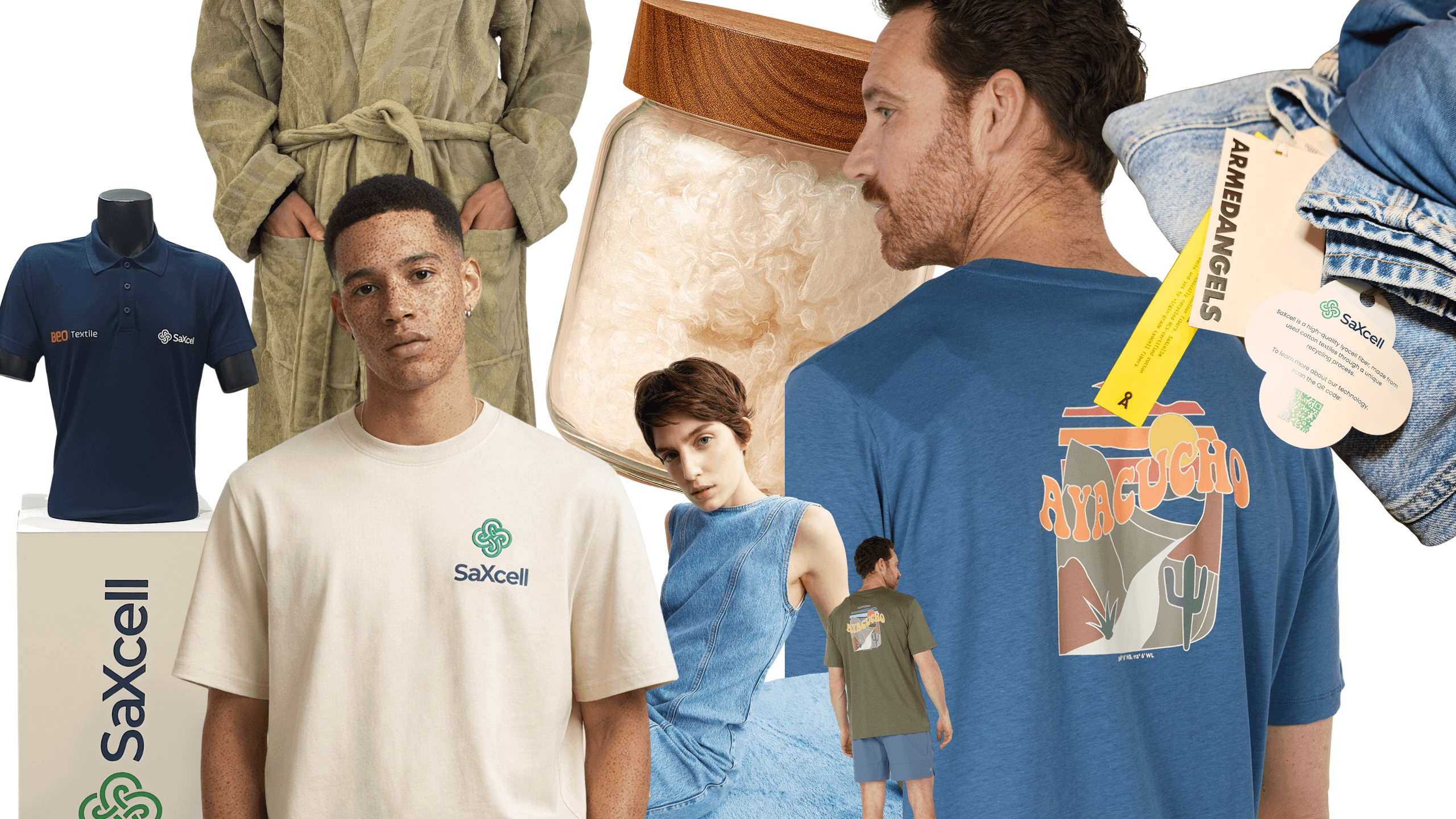
At SaXcell, this is the foundation of what we do. Our recycled lyocell fiber is engineered for performance across the full product lifecycle: consistent fiber length, higher tenacity, and the structural integrity that makes a garment worth keeping, passing on, or selling again.
Durability isn't the enemy of business growth. The absence of it is.
Let’s build your next durable and sustainable collection together.